

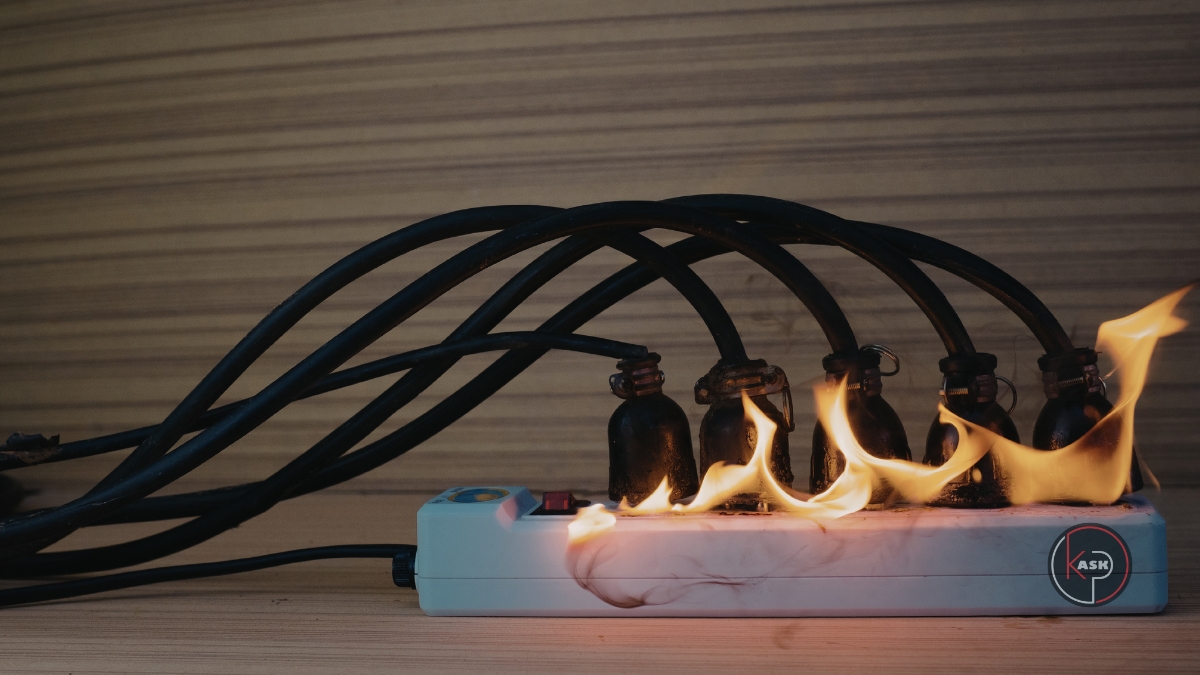
When the temperature drops, the priority is simple: stay warm. It is tempting to grab a space heater and an extension cord to reach that one drafty corner of the room. However, this common convenience is one of the most frequent causes of residential fires.
At Ask KP, we focus on clear answers for real-world decisions. Understanding the technical “why” behind electrical safety helps you manage your environment with the same rigor you apply to your business or professional life. Here is the breakdown of why high-draw appliances require a dedicated path to power and which devices pose the greatest risk to your home.
The Science of Resistance: Why Extension Cords Fail
To understand the danger, you have to understand electrical resistance. Every wire has a limit to how much current (amperage) it can safely carry. When you plug a high-wattage appliance into a standard extension cord, you are often forcing more “traffic” through the wire than it was designed to handle.
This restriction creates friction at the molecular level, which manifests as heat. Because most extension cords are bundled or tucked away under rugs or behind furniture, that heat cannot dissipate. Eventually, the insulation melts, sparking a fire. Portable heaters are “high-draw” devices, meaning they pull a massive, consistent amount of electricity. If that current isn’t moving through a wall outlet designed for heavy loads, you are essentially creating a heating element out of your power cord.
1. Portable Space Heaters: The Primary Fire Risk
Space heaters are responsible for an estimated 1,700 home fires annually. The core issue is duration and draw. Unlike a lamp that sips electricity, a heater gulps it. Most portable heaters operate at 1,500 watts. A standard household extension cord is often only rated for 1,000 to 1,200 watts. When you bridge that gap with a cheap cord, the cord becomes a fuse that doesn’t blow – it just burns.
2. Air Fryers: The Kitchen’s High-Wattage Heavyweight
Air fryers have become a countertop staple, but their power requirements are immense. Some models draw up to 2,000 watts to rapidly heat the internal coils. This exceeds the capacity of almost all standard power strips and extension cords. Because they generate intense heat internally, any additional heat generated by a strained power cord creates a high-risk environment in your kitchen.
3. Microwaves: The Need for a Dedicated Circuit
Microwaves are heavy-duty appliances that require a significant “surge” of power to begin the heating process. In modern home construction, microwaves are often given their own dedicated circuit for a reason. If yours is a countertop model, plugging it into a shared extension cord can cause the voltage to drop, potentially damaging the microwave’s sensitive electronics or overheating the cord during a long cook cycle.
4. Toasters and Toaster Ovens: Small Size, Big Draw
It is a common misconception that smaller appliances are “safer” for power strips. Toasters and toaster ovens use between 1,200 and 1,400 watts to glow those heating elements red-hot. Because these are often used in high-moisture areas like kitchens, using an extension cord adds an unnecessary layer of risk for both electrical fires and short circuits.
5. Refrigerators: The Danger of Constant Operation
Refrigerators actually draw less wattage (300 to 800 watts) than a space heater, but the danger lies in their “duty cycle.” A fridge runs 24/7. An extension cord is intended for temporary use. Over months of constant cycling on and off, the physical connections in an extension cord can degrade. This leads to voltage fluctuations that can burn out your refrigerator’s compressor – an expensive consequence for a “temporary” wiring fix.
6. Air Conditioning Units: Matching Power to BTU
Similar to space heaters, AC units are high-draw machines. They require a steady, high-volume flow of electricity to power the compressor. Using an extension cord can starve the unit of the power it needs, causing it to run inefficiently or overheat. Always ensure your AC is plugged directly into a grounded wall outlet, and use a BTU calculator to ensure your unit is correctly sized for the room to prevent constant “short-cycling.”
7. The “Daisy Chaining” Trap: Why Multiple Cords Fail
“Daisy chaining” is the practice of plugging one extension cord or power strip into another. This is a violation of nearly every fire safety code. Each “link” in the chain creates a point of electrical resistance. Even if the devices plugged in are low-power, the cumulative resistance across multiple cord junctions can cause the primary cord – the one plugged into the wall – to overheat and ignite without ever tripping a circuit breaker.
Practical Steps for a Safer Space
The rule of thumb for real-world safety is simple: If it’s designed to change the temperature (heat or cold) or move a heavy motor, it belongs in the wall.
- Check the Tag: Every appliance has a silver or white sticker listing its wattage. If it’s over 1,000 watts, skip the cord.
- Feel the Cord: If an extension cord is warm to the touch while in use, unplug it immediately. This is a sign of an electrical overload.
- Invest in Outlets: If you find yourself needing an extension cord permanently, the “Clear Answer” is to hire an electrician to install a new outlet. It is a minor investment compared to the cost of a fire.
By making informed decisions about how you power your home, you protect your property and, more importantly, the people inside it. Stay warm, but stay grounded.