
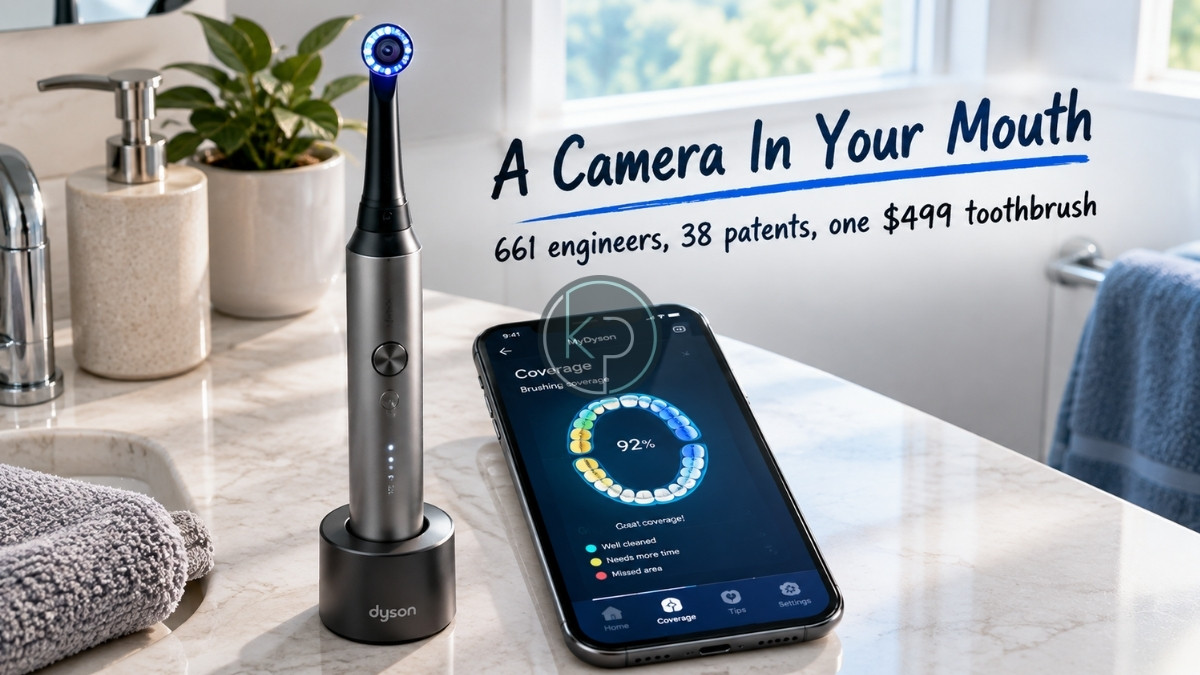
Yes, Dyson made a $499 toothbrush with a camera in it, and no, it doesn't upload footage of your mouth anywhere. The CameraJet uses a 100,000-pixel macro lens shooting 28 images a second to spot gaps between your teeth, then fires a precision water jet at each one within 100 milliseconds. It took 661 Dyson engineers six years and 38 patents to build a toothbrush that solves the one problem toothbrushes have always had: nobody flosses.
What 661 Engineers Actually Built Into a Toothbrush
The number that stopped me cold reading Dyson's own announcement wasn't the price. It was the code. This thing runs on 16 million lines of code, trained on more than 470,000 dental images, to power a system Dyson calls Gap Optical Targeting. That's the machine learning model finding the exact spot between your teeth where a normal bristle can't reach, then routing a jet of water there before you've even finished the stroke. Somewhere at Dyson HQ there's a team that spent six years perfecting the art of finding gaps in teeth, and I genuinely don't know whether to respect that or worry about it.
Why the Camera Doesn't Upload Anything to Dyson's Servers
Here's the part that actually matters if a camera pointed into your mouth twice a day sounds like a bad idea to you, which, reasonably, it might. Dyson says the camera is only active during live viewing or while it's auto-jetting, and that no images get recorded or stored, not on the device, not in the cloud. The processing happens on the toothbrush itself in real time and then it's gone. That's a real, specific privacy claim, not a vague "we take your privacy seriously" line, and it's worth noting Dyson got ahead of the obvious question before reviewers even had to ask it.
Why a Toothbrush Needed a Companion App and Wi-Fi
The CameraJet connects over 2.4GHz Wi-Fi and Bluetooth to the MyDyson app for guided cleaning and coverage mapping, so yes, your toothbrush is now a connected device on your home network. I'll say what I think plenty of readers are already thinking: the plaque removal claims are real and independently tested, up to 69% more than premium electric toothbrushes in hard-to-reach spots, but you don't need real-time computer vision and a home Wi-Fi connection to get people to floss. You need people to actually floss. Dyson built the version of that solution with the most patents in it.
Still, if you're the kind of person who's never once flossed consistently in your life, and I'd guess that's most of us, a device that makes the decision for you in real time might genuinely work where a New Year's resolution never did.