

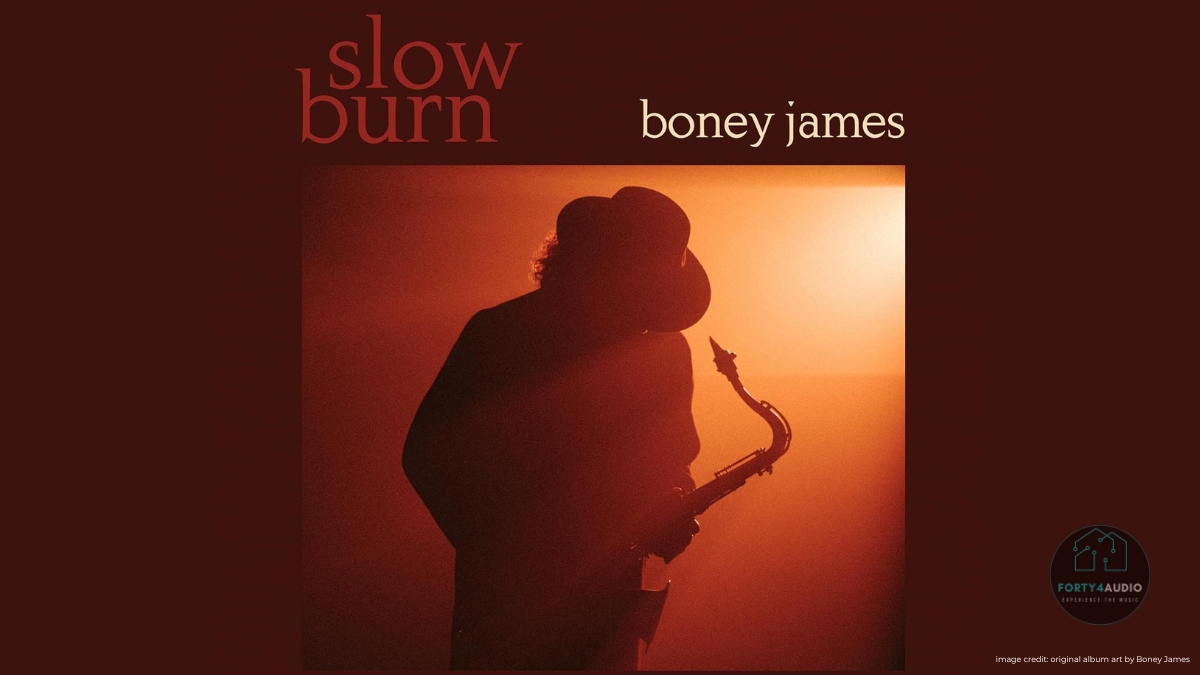
There is a specific kind of patience required to sit with a saxophone. It is an instrument that mimics the human voice but possesses a sustain that no breath can fully hold. On Slow Burn, the nineteenth entry in Boney James‘s long-term dialogue with the instrument, the title isn’t just a name; it is an instruction for how to approach the ten tracks that follow.
The album begins with “Arcadia.” The presence of Marcus Miller provides a foundational weight here, but the track functions primarily as an opening of a door. It sets a temperature – warm, steady, and unhurried. It is the sound of settling into a chair before the evening truly begins.
As the needle moves into “Butterfly,” featuring Cory Henry alongside Miller, the texture shifts. This is an homage to Herbie Hancock, but it doesn’t rush to prove its lineage. It moves with a deliberate, fluttering grace. Through repeated listening, you start to notice the way the keys and the sax play a game of shadows, one following the other into the corners of the room.
The title track, “Slow Burn,” arrives exactly when the pulse has fully calibrated to the record’s heart rate. It is the anchor of the first side. It demands that you stop anticipating the next transition and simply exist within the current one.
When October London‘s voice enters on “All I Want Is You,” it feels less like a guest feature and more like a natural evolution of the melody. The transition from the purely instrumental “Slow Burn” into this vocal performance is seamless – a testament to the sequencing. The human voice picks up the narrative thread exactly where the saxophone laid it down.
“Slide” follows, acting as a bridge. It provides a momentary lift, a slight increase in cadence that prevents the listener from drifting too far into the ether. It prepares the ear for “A Little Romance,” a track that benefits most from a quiet room and the absence of digital distraction. Here, the phrasing is sparse. It is a study in what is left out.
“Gonna Have a Good Time” and “The Bounce” function as the album’s center of gravity in terms of movement. They are rhythmic, yet they maintain the forty4 Audio ethos of restraint. They don’t shout for attention; they invite a rhythmic awareness that is felt in the chest more than the ears.
As the record begins its final descent, “Between the Lines” asks for a different kind of focus. It is a track that reveals its complexities only after the fourth or fifth pass. The nuances in the breath control, the slight reediness of certain notes – these are the details that emerge when you stop listening for a hook and start listening for a person.
The closing track, “Sugar,” featuring Rick Braun, is a nod to Stanley Turrentine. It is the perfect coda. It brings the journey full circle, leaning into a classicism that feels timeless rather than nostalgic. It doesn’t end with a grand flourish. Instead, it slowly recedes, leaving the room a little quieter than it was forty-five minutes ago.
The silence that follows the final note of “Sugar” is as much a part of the album as the music itself. It is the space where the listening settles.