
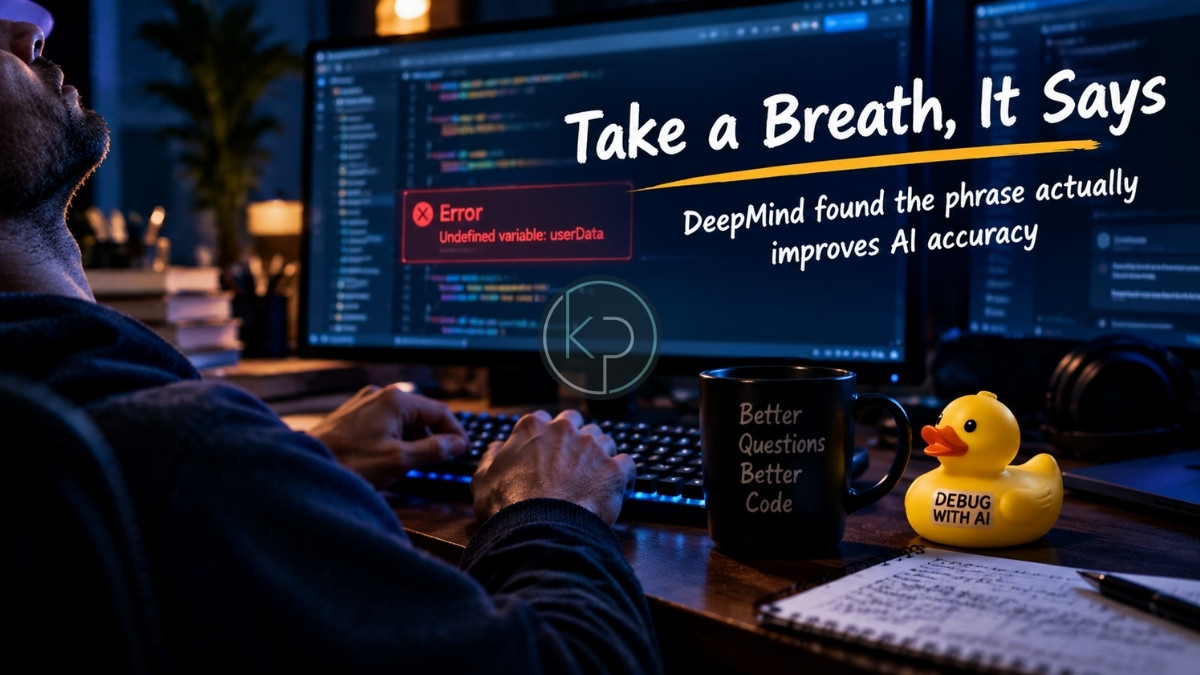
Yes, telling an AI model to "take a breath" or "lock in" before it tries again can genuinely improve its output, and no, it's not because the model is stressed. Researchers at Google DeepMind found that adding the phrase "take a deep breath and work on this problem step by step" to a prompt measurably boosted a model's accuracy on math problems. Separate research out of Microsoft found that emotionally loaded phrases like "this is important for my career" improved response quality by nearly 11% on average. The pep talk isn't superstition. It's a real, if slightly embarrassing, prompting trick with actual data behind it.
What Google DeepMind Actually Found About "Take a Deep Breath"
DeepMind wasn't trying to prove AI has feelings. They were testing whether an AI could optimize its own prompts by trying thousands of variations and measuring which ones worked best on math word problems. Out of everything tested, "take a deep breath" and "work on this problem step by step" came out on top, beating out prompts that meant the exact same thing in plainer language. The researchers themselves said instructions carrying identical meaning triggered wildly different behavior in the model, and they don't fully know why. That's the honest, slightly unsatisfying answer: it works, and the people who found it working can't fully explain the mechanism either.
Why "Count to Ten" Works Even Though the Model Isn't Counting
Here's my actual theory, for what it's worth. Phrases like "take a breath" and "count to ten" are almost always followed, in the trillions of words a model trained on, by careful, deliberate, step-by-step behavior. Telling a model to slow down doesn't calm it down, because it has no nervous system to calm. It nudges the model toward the pattern of language that shows up right after "slow down" in its training data, which tends to be more methodical, less rushed, more like someone actually working the problem instead of guessing. You're not soothing the AI. You're steering it toward a different neighborhood of its own training data.
Why "Lock In" Might Just Be a Placebo for the Developer
I'll be honest about the part that's probably not doing anything to the model at all: the developer's own ritual. Telling your AI to "lock in" before a retry might do nothing measurable to its output, but it does something to you. It's a pause. It's a moment where you stop hammering the same broken prompt and actually think about what you're asking for differently. If the pep talk makes you slow down and rewrite a clearer request, that's the real fix, and the goblin-brain ritual around it is just how you talked yourself into doing it.
What I'd Actually Type Instead of "Take a Breath"
If you want the real version of this trick, skip the vibes and use the documented one: ask the model to work through the problem step by step, out loud, before giving a final answer. That's the mechanism researchers actually found driving the improvement. The breathing part is optional. The step-by-step part is doing the work.