
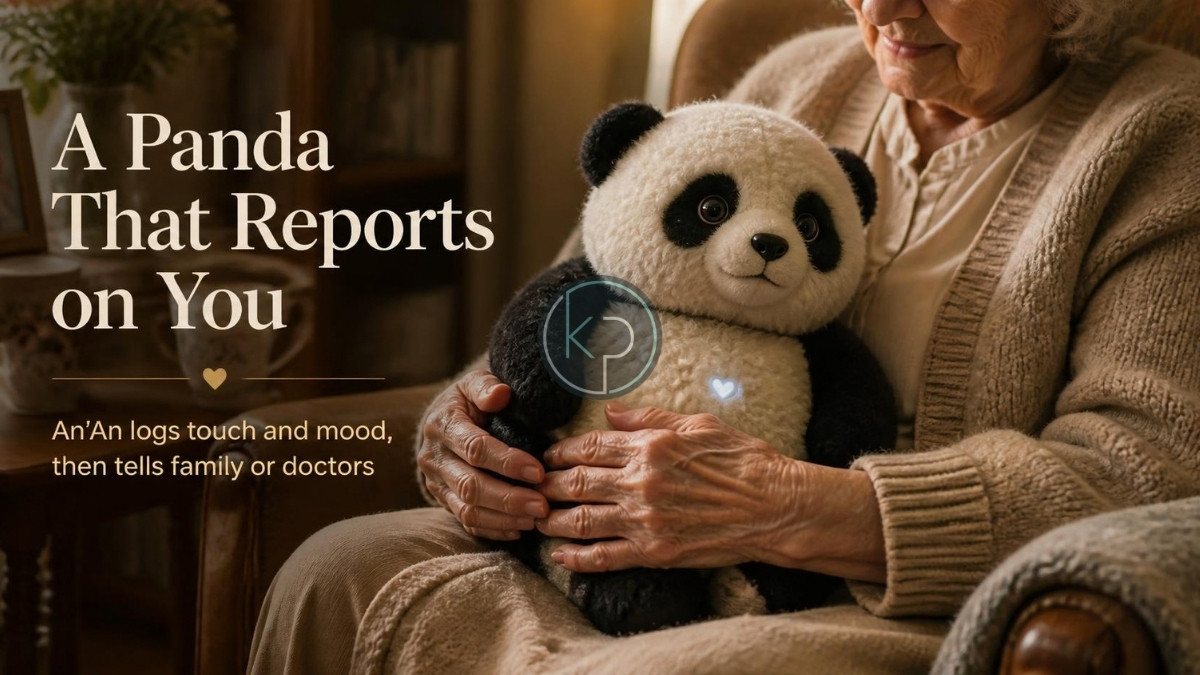
Yes, there's a real AI panda that lives with your grandparent, tracks how often they get touched and talked to, and reports the patterns to family. It's called An'An, built by Mind With Heart Robotics, and it won a CES Innovation Award for it. It's soft, it's handcrafted, and it is, in a very literal sense, watching.
What's Actually Inside a Stuffed Panda With 10 Sensor Suites
An'An isn't a plush toy with a chip glued in. It's wrapped in real Australian wool and sheepskin, so it feels like an actual animal, but underneath that softness is more than ten sensor suites: full-body touch sensing, a microphone, motion tracking, the works. It knows the difference between a stroke, a squeeze, and a hug. Most stuffed animals know the difference between "on the floor" and "not on the floor." This one's a bigger upgrade than that sounds.
Why It Remembers Your Grandmother's Voice Better Than You Do
An'An builds a memory profile from voice patterns and touch habits, and it keeps refining that profile over weeks and months. It's not just reacting, it's adapting to one specific person's specific way of talking and touching it. Give it long enough and it genuinely knows something about your grandmother's daily rhythm that you, checking in by phone once a week, probably don't.
The Clinical Version That Sends Reports to a Doctor, Not Just Family
There's a B2B clinical version aimed at assisted living facilities and dementia care, and this is where it stops being cute and starts being genuinely useful. It logs touch patterns, conversation cues, and behavioral changes, then pushes the trends to a secure dashboard clinicians can actually read. In early testing with Hong Kong's Jockey Club Centre for Positive Ageing, researchers saw measurable mood improvement in older adults with mild cognitive impairment. That's not marketing copy. That's a real study, with a real result, attached to a stuffed panda.
Why This Costs a Fifth of What Therapeutic Robots Usually Do
The company is targeting roughly one-fifth the price of existing therapeutic robots like PARO, the seal robot hospitals have used for over a decade. No public number exists yet, mass production started in March 2026, but "PARO, for a fraction of the cost" is a genuinely compelling pitch if you've priced one of those out.
Would I Actually Put One In My Mom's Apartment?
Here's my honest read: the surveillance instinct in me wants to be weirded out by a stuffed animal quietly logging how often someone gets hugged. But the actual data behind this, real sensors, a real clinical study, a real mood improvement, is more convincing than creepy (maybe! maybe not!). If it means catching a bad week before it becomes a bad month, I'll take the panda filing the report.