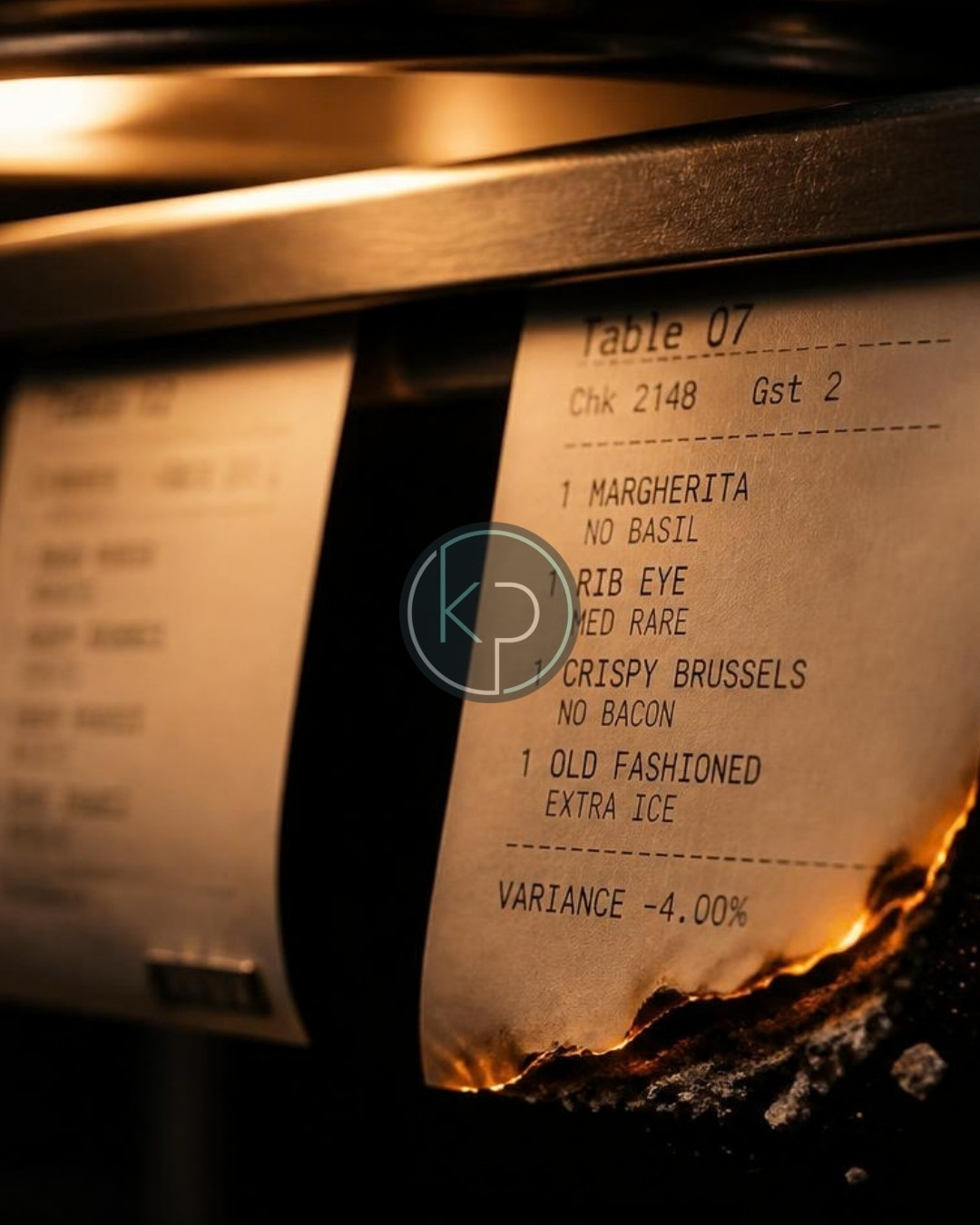
Your menu is the most important database your restaurant group owns because nearly every number you manage starts with it. Pricing, inventory depletion, delivery listings, prep and labor forecasting, and theoretical food cost all flow from how each item and modifier is built in the POS. When that structure is inconsistent across locations or channels, every report downstream is wrong — and nobody can see why.
Most groups treat the menu like a design file. Something marketing updates, the printer prints, and someone types into the POS. That's the mistake. The printed menu is the least important version of your menu.
A restaurant menu is master data, not a design file
In enterprise terms, master data is the core record every other system depends on. For a retailer it's the product catalog. For a restaurant group it's the menu.
Every time a server rings an item, the POS records a sale, depletes recipe ingredients, routes a ticket to a station, updates the sales mix, and feeds whatever forecasting and reporting tools sit downstream. If the item was built correctly, all of that is accurate. If it wasn't, all of that is accurately wrong.
That's why I treat the menu build as an operations decision, not a design task. The person building items in the POS is effectively writing the rules for your food cost reporting.
What a single menu item controls in a multi-unit restaurant group
Take one item: a large pizza. In a well-built system that one record decides:
- Price by location and by channel, including any delivery differential
- Inventory depletion through its recipe, down to the ounce of cheese
- Kitchen routing to the right station and display screen
- Delivery listings, including names, descriptions, and availability on every platform
- Sales mix reporting, which feeds prep pars and labor forecasts
- Theoretical food cost, which is the benchmark every variance report compares against
Get that one record wrong and you don't have one problem. You have six, spread across six reports owned by six different people.
How inconsistent modifiers break every report you run
Items are usually built fine. Modifiers are where it falls apart.
Modifiers are the add-ons, substitutions, sizes, and options attached to an item. "Extra cheese." "Sub gluten-free crust." "Light sauce." "Add chicken." They're built quickly, often by whoever is closest to the terminal, and rarely reviewed again.
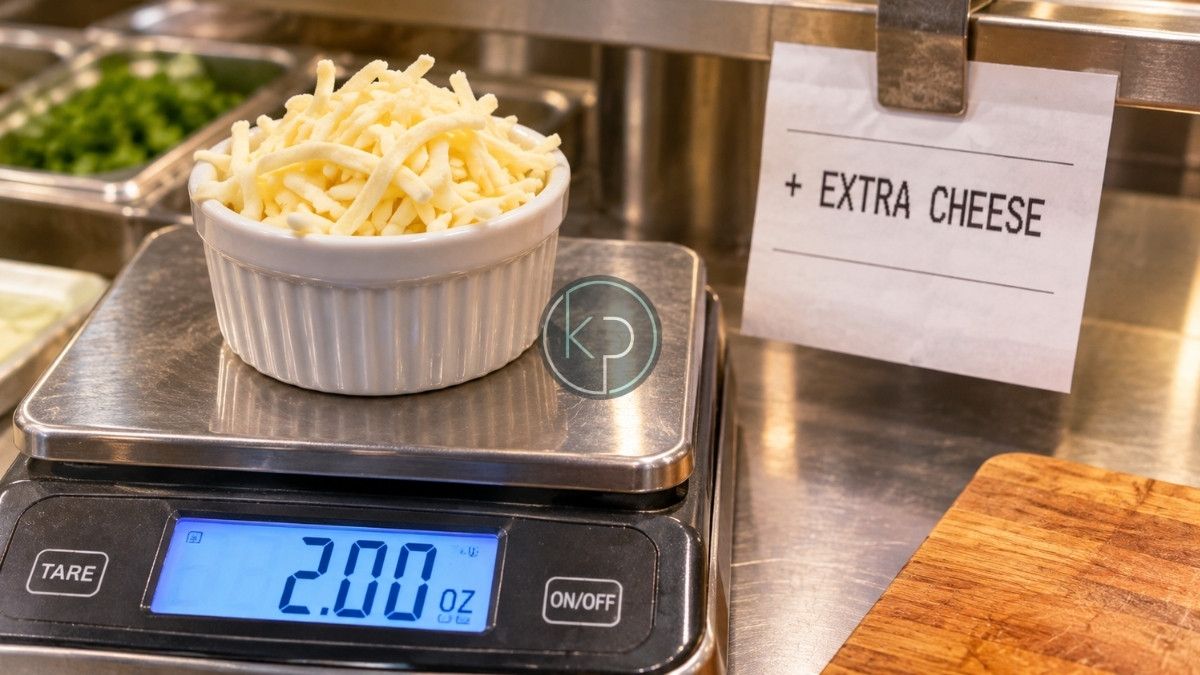
Here's what that looks like across a group. One location builds "Extra Cheese" as a $2.00 modifier tied to a two-ounce recipe. Another builds it as a $1.50 open-priced modifier with no recipe at all. A third has "Xtra Chz" left over from an old menu. The delivery platforms have their own version, which the middleware maps to whichever one matched first.
Now ask a simple question: how much cheese did we sell last month? There isn't a real answer. There are four partial ones.
If the same modifier is built differently in two places, you can't compare those two places. Not their food cost, not their sales mix, not their margins.
Why item mapping is where theoretical food cost goes to die
Theoretical food cost is what your food cost should be, based on what you sold and what each item's recipe says it uses. Actual food cost comes from inventory counts and purchases. The gap between the two is variance, and variance is how you find waste, over-portioning, and theft.
That whole comparison depends on mapping. Every item and modifier has to be linked to a recipe, and every sale has to land on the right item.
Three things break it constantly:
- Unmapped modifiers. A modifier with no recipe depletes nothing. Sell 400 orders of extra cheese and your theoretical cost says you used zero.
- Open items. When a server rings "open food $4" because the right button didn't exist, the sale is real but the recipe is invisible.
- Channel mismatches. Delivery orders that come through middleware and land on a generic or wrong item. The guest gets the food. The inventory system never hears about it.
When enough of that piles up, your variance report stops meaning anything. Managers learn to ignore it. And once a variance report gets ignored, it's no longer a control.
Building a modifier hierarchy that holds up across locations and channels
The fix is structure, decided once, centrally.
Standardize modifier groups before individual modifiers
Define the groups first: sizes, crusts, proteins, add-ons, preparation instructions. Each group gets rules, such as required or optional, how many choices, and whether it carries a price. Then every item uses those same groups instead of its own custom versions.
Separate priced modifiers from kitchen instructions
"Add bacon" changes price and inventory. "Well done" changes neither. Keep them in different groups so instructions never pollute cost data and priced add-ons never get treated as free notes.
Attach a recipe to anything that uses product
If a modifier puts food on a plate, it gets a recipe. No exceptions. That single rule closes more variance than most inventory software ever will.
One master menu pushed to every channel
The structure only holds if there's one place where it's maintained. That means a single master menu — in the POS or a menu management layer above it — that pushes to every location, kiosk, online ordering site, and delivery platform.
Locations can still have their own prices and availability. What they shouldn't have is their own build. Price is a setting. Structure is a standard.
When a new item launches, it gets built once, mapped once, and published everywhere. When something changes, it changes once. That's the whole goal.
How to audit your restaurant menu data this month
You don't need a project plan to find out how bad it is. Pull these reports and look honestly:
- Every modifier with no recipe attached
- Open-item sales by location for the last 30 days
- Duplicate or near-duplicate items and modifiers across stores
- Delivery orders landing on unmapped or generic items
If those lists are long, your food cost reports are guesses. The good news is that this is one of the cheapest problems in a restaurant group to fix. It doesn't take new software. It takes deciding that the menu is data, and treating it that way.